How to Layer Rugs for Fall and Winter
How to layer rugs for fall and winter: which base rug to use, the sizes that work together, color pairings for cold months and the mistakes to avoid.
When the clocks go back and the evenings close in, most rooms need more warmth than a new throw can give them. Layering rugs is one of the most effective ways to get it. A second rug adds softness underfoot, a little insulation over cold floors, and a richer, more collected look. It also lets you change a room for the season without replacing anything you already love.
Done well, layered rugs look deliberate. Done badly, they look like two rugs that happened to end up in the same place. The difference comes down to a few decisions: the base, the size relationship, the color pairing and where the top rug sits.
Start with a flat, quiet base
The bottom rug does the structural work. It defines the zone, anchors the furniture and gives the top rug a frame. That means it should be flat and low: a flat-weave wool, jute, sisal or a simple woven cotton. A thin base keeps the combined height manageable, stops the top rug from rocking, and makes it easier for chair legs and feet to move across the edge.
Avoid stacking two deep-pile rugs. Two thick layers create a soft, unstable surface that shifts underfoot and becomes a trip hazard, especially at the edges. Keep the texture on top and the structure underneath.
Put a good rug pad under the base layer, sized about 1 inch smaller than the rug on every side. It stops the whole arrangement from sliding on hardwood or stone, and it protects the floor.
Get the sizes right
The most common layering mistake is choosing two rugs that are too close in size. If only a few inches of the base show, it looks like a mistake rather than a choice. As a working rule, let 12 to 18 inches of the base rug show on each side of the top rug.
- 6 x 9 ft on 9 x 12 ft: 18 inches of base on every side. Generous and easy to get right in a living room.
- 6 x 9 ft on 8 x 10 ft: 12 inches on every side. Neat and tailored, good for smaller rooms.
- 8 x 10 ft on 10 x 14 ft: 24 inches all around. Works in large, open-plan rooms where the base needs to hold a whole seating group.
The base should still follow the normal rules for the room: in a living room, the front legs of the sofa and chairs should sit on it. The top rug can be smaller and float in the center, under the coffee table and the main path between seats. For the fundamentals, our guide on how to choose a rug size walks through each room.
Let 12 to 18 inches of the base rug show on each side. Less than that looks like a mistake rather than a choice.
Choose colors for the cold months
Fall and winter light is lower and warmer, and it flatters deeper colors. That makes it a good time to bring in a saturated top rug over a neutral base. A few pairings that work:
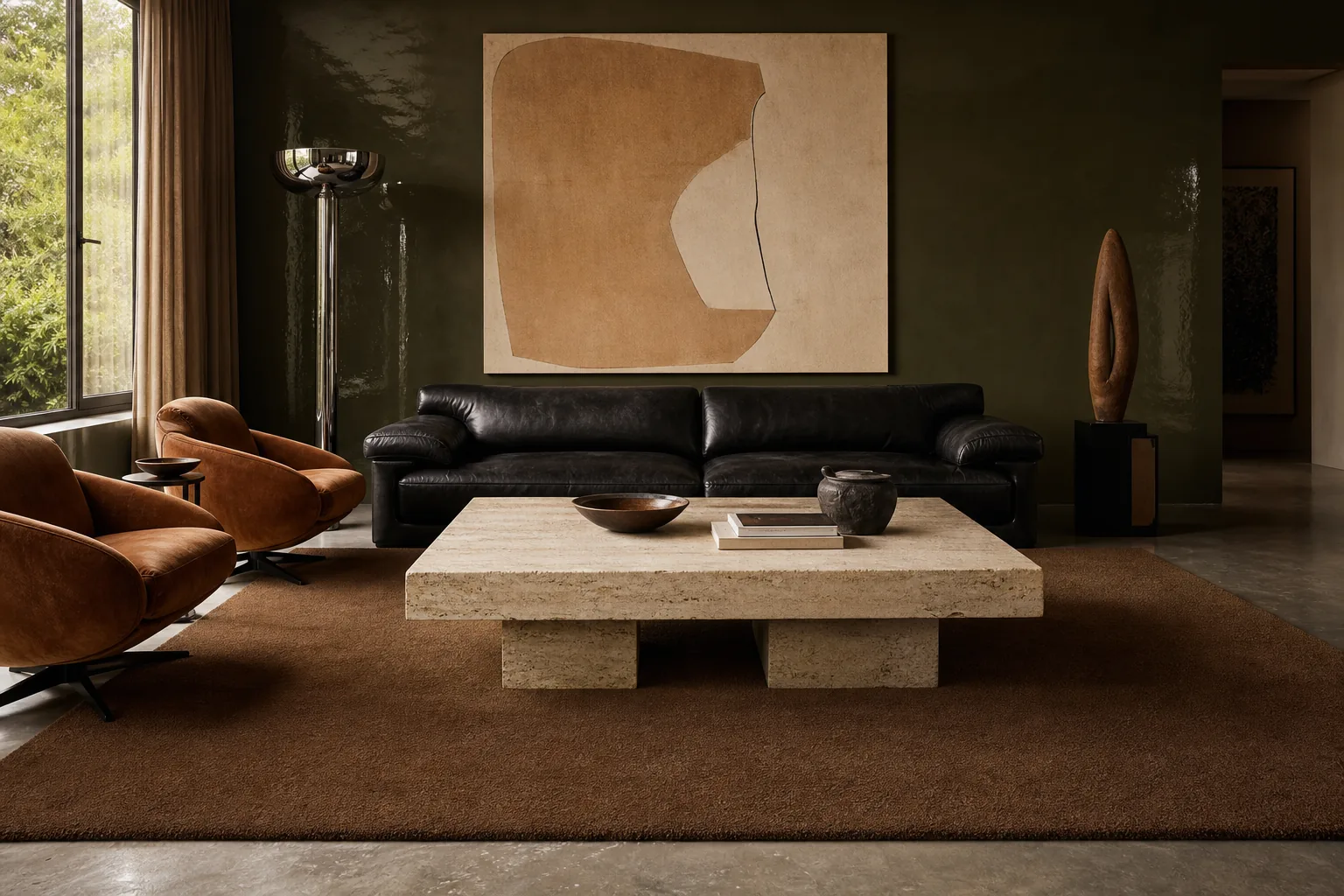
- Warm on natural: a brown, rust or cognac rug over natural jute or oatmeal wool. The classic fall combination, and very forgiving.
- Deep on pale: navy, forest or aubergine over an ivory or light gray flat-weave. Strong contrast, crisp edges, and it reads clearly from across the room.
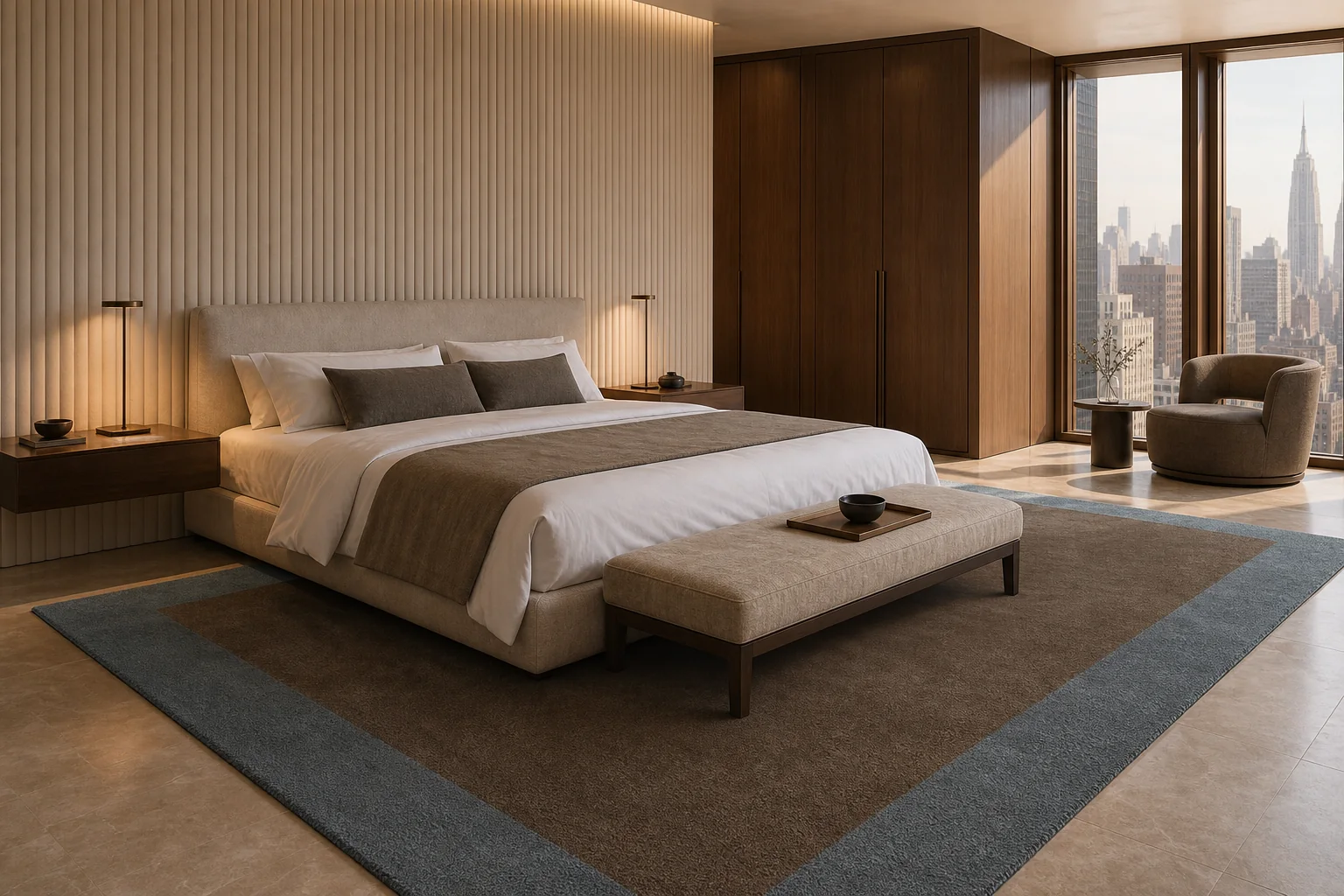
- Tone on tone: two shades of the same family, such as a dark chocolate over a mid-brown, or a deep blue over a soft blue-gray. Quieter and more sophisticated, with the layering felt as much as seen.
If you are unsure, take your cue from what is already in the room. Pick the top rug color from upholstery, curtains or artwork, and keep the base in the same temperature as your walls and floor. Warm wood floors and cream walls want a warm base; cool stone and white walls suit a gray or flax one.
Let texture do the talking
Layering is as much about texture as color. The most satisfying combinations pair contrasting surfaces: the dry, nubby weave of jute or sisal against a soft, dense pile; a flat, matte wool against a rug with more depth and sheen. That contrast is what makes the arrangement look considered rather than accidental.
A solid top rug is the easiest place to start. With no pattern on top, the eye reads the two textures and the two colors cleanly. If your base has a pattern, such as a stripe or a small check, keep the top rug plain. Two patterns together are possible, but they need a shared color and a clear difference in scale.
Placement: centered or at an angle
Most of the time, center the top rug on the base and align their edges. It is calm, architectural and suits most rooms. In a more relaxed space, such as a reading corner, a den or a bedroom, you can turn the top rug a few degrees off square or offset it toward the seating. Commit to the angle so it reads as intentional, and keep the rest of the room orderly so it does not feel messy.
In a bedroom, a layered rug works well at the foot of the bed or along one side, where your feet land first thing on a cold morning. A smaller top rug over a larger base gives you both the anchor and the softness.
Practical checks before you commit
- Doors: make sure every door that opens over the rugs clears their combined height, including the pad.
- Edges: watch the transition at walkways. If a top rug edge sits across a busy path, move it or choose a slimmer base.
- Cleaning: vacuum both layers. Lift the top rug every few weeks so grit does not grind into the base beneath it.
- Spring: plan for the swap. Many people keep the base all year and roll up the top rug when the weather warms.
Or get the look in a single rug
If you like the depth of a layered look but want something simpler to live with, a bordered rug gives you both colors in one piece. Our Thick rugs hold a quiet center inside a broad border in a second color, so a pairing like Oud and Horizon reads like a layered arrangement with none of the shifting edges.
For the classic approach, our Intense rugs make an ideal top layer: one saturated color in a dense 14 mm pile, in New Zealand wool or ECONYL regenerated nylon, in colorways like Saddle, Oud and Brick that suit the colder months. If your room calls for a size or color combination you cannot find, you can design it in our Studio, or talk to us about what you have in mind. And for help choosing what goes on top of the rug, see our sofa and rug pairing guide.